When a Potato Is Compressed Does It Strain Harden Then Weaken Then Harden Again
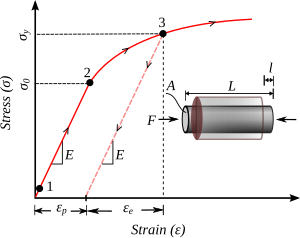
A phenomenological uniaxial stress–strain curve showing typical work hardening plastic behavior of materials in uniaxial pinch. For work hardening materials the yield stress increases with increasing plastic deformation. The strain can exist decomposed into a recoverable elastic strain (εdue east ) and an inelastic strain (εp ). The stress at initial yield is σ0 .
In materials science, piece of work hardening, also known every bit strain hardening, is the strengthening of a metallic or polymer by plastic deformation. Work hardening may exist desirable, undesirable, or inconsequential, depending on the context.
This strengthening occurs because of dislocation movements and dislocation generation inside the crystal structure of the material.[i] Many non-brittle metals with a reasonably high melting point besides as several polymers can be strengthened in this way.[2] Alloys non acquiescent to heat treatment, including low-carbon steel, are often work-hardened. Some materials cannot be piece of work-hardened at low temperatures, such as indium,[3] however others tin can be strengthened only via work hardening, such as pure copper and aluminum.[4]
Undesirable work hardening [edit]
An instance of undesirable work hardening is during machining when early passes of a cutter inadvertently work-harden the workpiece surface, causing harm to the cutter during the later passes. Certain alloys are more prone to this than others; superalloys such as Inconel require machining strategies that accept it into account.
For metal objects designed to flex, such as springs, specialized alloys are usually employed in gild to avoid work hardening (a result of plastic deformation) and metal fatigue, with specific rut treatments required to obtain the necessary characteristics.
Intentional work hardening [edit]
An example of desirable work hardening is that which occurs in metalworking processes that intentionally induce plastic deformation to exact a shape change. These processes are known every bit cold working or common cold forming processes. They are characterized by shaping the workpiece at a temperature beneath its recrystallization temperature, usually at ambient temperature.[five] Cold forming techniques are usually classified into four major groups: squeezing, bending, cartoon, and shearing. Applications include the heading of bolts and cap screws and the finishing of cold rolled steel. In cold forming, metal is formed at loftier speed and high pressure using tool steel or carbide dies. The common cold working of the metal increases the hardness, yield force, and tensile strength.[vi]
Theory [edit]
Earlier work hardening, the lattice of the material exhibits a regular, nearly defect-complimentary design (near no dislocations). The defect-gratis lattice can be created or restored at whatsoever fourth dimension past annealing. Every bit the material is work hardened it becomes increasingly saturated with new dislocations, and more than dislocations are prevented from nucleating (a resistance to dislocation-formation develops). This resistance to dislocation-formation manifests itself as a resistance to plastic deformation; hence, the observed strengthening.
In metal crystals, this is a reversible procedure and is usually carried out on a microscopic scale by defects called dislocations, which are created by fluctuations in local stress fields within the material culminating in a lattice rearrangement as the dislocations propagate through the lattice. At normal temperatures the dislocations are not annihilated by annealing. Instead, the dislocations accumulate, interact with i some other, and serve as pinning points or obstacles that significantly impede their motion. This leads to an increase in the yield force of the material and a subsequent decrease in ductility.
Such deformation increases the concentration of dislocations which may afterward course low-angle grain boundaries surrounding sub-grains. Cold working more often than not results in a higher yield strength as a result of the increased number of dislocations and the Hall–Petch effect of the sub-grains, and a decrease in ductility. The effects of common cold working may be reversed by annealing the material at high temperatures where recovery and recrystallization reduce the dislocation density.
A material's piece of work hardenability tin be predicted by analyzing a stress–strain curve, or studied in context by performing hardness tests earlier and after a process.[7] [8]
Elastic and plastic deformation [edit]
Piece of work hardening is a consequence of plastic deformation, a permanent change in shape. This is distinct from rubberband deformation, which is reversible. Nearly materials do not exhibit only one or the other, but rather a combination of the two. The post-obit discussion more often than not applies to metals, especially steels, which are well studied. Work hardening occurs about notably for ductile materials such as metals. Ductility is the ability of a material to undergo plastic deformations before fracture (for instance, angle a steel rod until it finally breaks).
The tensile exam is widely used to written report deformation mechanisms. This is because nether pinch, almost materials will experience trivial (lattice mismatch) and non-niggling (buckling) events before plastic deformation or fracture occur. Hence the intermediate processes that occur to the material nether uniaxial compression earlier the incidence of plastic deformation make the compressive test fraught with difficulties.
A fabric more often than not deforms elastically nether the influence of small forces; the material returns quickly to its original shape when the deforming force is removed. This phenomenon is called elastic deformation. This behavior in materials is described by Hooke'southward Police force. Materials conduct elastically until the deforming strength increases beyond the elastic limit, which is besides known equally the yield stress. At that point, the material is permanently deformed and fails to return to its original shape when the force is removed. This phenomenon is called plastic deformation. For example, if one stretches a coil spring upward to a certain point, it volition render to its original shape, but one time it is stretched beyond the elastic limit, it volition remain deformed and won't return to its original state.
Rubberband deformation stretches the bonds between atoms abroad from their equilibrium radius of separation, without applying enough energy to break the inter-atomic bonds. Plastic deformation, on the other hand, breaks inter-atomic bonds, and therefore involves the rearrangement of atoms in a solid material.
Dislocations and lattice strain fields [edit]
In materials science parlance, dislocations are defined as line defects in a material's crystal structure. The bonds surrounding the dislocation are already elastically strained by the defect compared to the bonds betwixt the constituents of the regular crystal lattice. Therefore, these bonds pause at relatively lower stresses, leading to plastic deformation.
The strained bonds around a dislocation are characterized by lattice strain fields. For example, there are compressively strained bonds directly next to an edge dislocation and tensilely strained bonds beyond the end of an edge dislocation. These form compressive strain fields and tensile strain fields, respectively. Strain fields are analogous to electric fields in certain ways. Specifically, the strain fields of dislocations obey similar laws of allure and repulsion; in order to reduce overall strain, compressive strains are attracted to tensile strains, and vice versa.
The visible (macroscopic) results of plastic deformation are the issue of microscopic dislocation motion. For instance, the stretching of a steel rod in a tensile tester is accommodated through dislocation motion on the atomic scale.
Increase of dislocations and work hardening [edit]
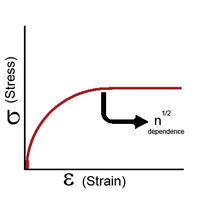
Figure 1: The yield stress of an ordered material has a half-root dependency on the number of dislocations present.
Increment in the number of dislocations is a quantification of piece of work hardening. Plastic deformation occurs equally a result of work being done on a material; energy is added to the fabric. In improver, the free energy is almost always applied fast enough and in large plenty magnitude to non just move existing dislocations, only also to produce a nifty number of new dislocations by jarring or working the material sufficiently plenty. New dislocations are generated in proximity to a Frank–Read source.
Yield strength is increased in a cold-worked material. Using lattice strain fields, it tin be shown that an environment filled with dislocations will hinder the movement of any one dislocation. Because dislocation move is hindered, plastic deformation cannot occur at normal stresses. Upon awarding of stresses just across the yield strength of the non-cold-worked cloth, a cold-worked material will continue to deform using the only machinery available: elastic deformation, the regular scheme of stretching or compressing of electrical bonds (without dislocation motion) continues to occur, and the modulus of elasticity is unchanged. Eventually the stress is great enough to overcome the strain-field interactions and plastic deformation resumes.
However, ductility of a work-hardened material is decreased. Ductility is the extent to which a material can undergo plastic deformation, that is, it is how far a cloth tin be plastically deformed before fracture. A cold-worked textile is, in consequence, a normal (breakable) material that has already been extended through part of its immune plastic deformation. If dislocation motion and plastic deformation have been hindered enough by dislocation accumulation, and stretching of electronic bonds and rubberband deformation have reached their limit, a tertiary mode of deformation occurs: fracture.
Quantification of work hardening [edit]
The forcefulness, , of dislocation is dependent on the shear modulus, G, the magnitude of the Burgers vector, b, and the dislocation density, :


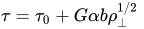
where is the intrinsic forcefulness of the cloth with low dislocation density and is a correction factor specific to the material.


As shown in Figure 1 and the equation higher up, work hardening has a half root dependency on the number of dislocations. The cloth exhibits loftier strength if there are either high levels of dislocations (greater than 10xiv dislocations per m2) or no dislocations. A moderate number of dislocations (between 10seven and 10nine dislocations per gii) typically results in low strength.
Example [edit]
For an extreme example, in a tensile examination a bar of steel is strained to just before the length at which it usually fractures. The load is released smoothly and the fabric relieves some of its strain by decreasing in length. The decrease in length is called the elastic recovery, and the end result is a piece of work-hardened steel bar. The fraction of length recovered (length recovered/original length) is equal to the yield-stress divided by the modulus of elasticity. (Here we hash out truthful stress in order to account for the desperate decrease in diameter in this tensile test.) The length recovered after removing a load from a material just before it breaks is equal to the length recovered after removing a load just before it enters plastic deformation.
The work-hardened steel bar has a big plenty number of dislocations that the strain field interaction prevents all plastic deformation. Subsequent deformation requires a stress that varies linearly with the strain observed, the slope of the graph of stress vs. strain is the modulus of elasticity, every bit usual.
The work-hardened steel bar fractures when the applied stress exceeds the usual fracture stress and the strain exceeds usual fracture strain. This may exist considered to exist the rubberband limit and the yield stress is now equal to the fracture toughness, which is much higher than a non-work-hardened steel yield stress.
The amount of plastic deformation possible is zero, which is less than the corporeality of plastic deformation possible for a non-work-hardened fabric. Thus, the ductility of the cold-worked bar is reduced.
Substantial and prolonged cavitation can also produce strain hardening.
Empirical relations [edit]
At that place are two common mathematical descriptions of the work hardening phenomenon. Hollomon's equation is a power law relationship between the stress and the corporeality of plastic strain:[9]

where σ is the stress, Yard is the strength index or strength coefficient, εp is the plastic strain and due north is the strain hardening exponent. Ludwik's equation is like simply includes the yield stress:
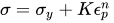
If a material has been subjected to prior deformation (at low temperature) then the yield stress will be increased by a gene depending on the amount of prior plastic strain ε0 :

The constant K is structure dependent and is influenced by processing while n is a material property normally lying in the range 0.two–0.5. The strain hardening index can be described past:
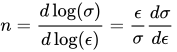
This equation tin can be evaluated from the slope of a log(σ) – log(ε) plot. Rearranging allows a decision of the rate of strain hardening at a given stress and strain:

Work hardening in specific materials [edit]
Copper [edit]
Copper was the starting time metallic in common utilise for tools and containers since it is 1 of the few metals available in non-oxidized form, not requiring the smelting of an ore. Copper is hands softened by heating and and so cooling (it does not harden by quenching, e.g., quenching in cool water). In this annealed state it may then be hammered, stretched and otherwise formed, progressing toward the desired concluding shape but becoming harder and less ductile equally work progresses. If work continues beyond a certain hardness the metal will tend to fracture when worked and so information technology may be re-annealed periodically as shaping continues. Annealing is stopped when the workpiece is most its final desired shape, and so the final product will have a desired stiffness and hardness. The technique of repoussé exploits these properties of copper, enabling the construction of durable jewelry articles and sculptures (such as the Statue of Liberty).
Gold and other precious metals [edit]
Much gold jewelry is produced by casting, with little or no common cold working; which, depending on the alloy grade, may leave the metal relatively soft and bendable. However, a Jeweler may intentionally use piece of work hardening to strengthen wearable objects that are exposed to stress, such as rings.
Aluminum [edit]
Devices fabricated from aluminum and its alloys, such as aircraft, must be advisedly designed to minimize or evenly distribute flexure, which can lead to work hardening and, in plough, stress cracking, possibly causing catastrophic failure. For this reason modern aluminum shipping volition have an imposed working lifetime (dependent upon the type of loads encountered), after which the aircraft must be retired.
References [edit]
- ^ Degarmo, Black & Kohser 2003, p. lx.
- ^ Van Melick, H. Thousand. H.; Govaert, L. E.; Meijer, H. Due east. H. (2003), "On the origin of strain hardening in glassy polymers", Polymer, 44 (8): 2493–2502, doi:10.1016/s0032-3861(03)00112-five
- ^ Swenson, C. A. (1955), "Properties of Indium and Thallium at depression temperatures", Physical Review, 100 (6): 1607–1614, Bibcode:1955PhRv..100.1607S, doi:10.1103/physrev.100.1607
- ^ Smith & Hashemi 2006, p. 246.
- ^ Degarmo, Blackness & Kohser 2003, p. 375.
- ^ Deringer-Ney, "Common cold Forming and Common cold Heading Process", April 29, 2014
- ^ Cheng, Y. T.; Cheng, C. M. (1998), "Scaling approach to conical indentation in elastic-plastic solids with work hardening" (PDF), Periodical of Applied Physics, 84 (three): 1284–1291, Bibcode:1998JAP....84.1284C, doi:10.1063/one.368196
- ^ Prawoto, Yunan (2013). Integration of Mechanics into Materials Scientific discipline Research: A Guide for Material Researchers in Analytical, Computational and Experimental Methods. Lulu.com. ISBN978-1-300-71235-0.
- ^ Hollomon, J.R. (1945). "Tensile deformation". Transactions of AIME. 162: 268–277.
Bibliography [edit]
- Degarmo, Eastward. Paul; Blackness, J T.; Kohser, Ronald A. (2003), Materials and Processes in Manufacturing (9th ed.), Wiley, ISBN978-0-471-65653-1 .
- Smith, William F.; Hashemi, Javad (2006), Foundations of Materials Science and Engineering (4th ed.), McGraw-Hill, ISBN978-0-07-295358-nine.
connellycirse1964.blogspot.com
Source: https://en.wikipedia.org/wiki/Work_hardening
Belum ada Komentar untuk "When a Potato Is Compressed Does It Strain Harden Then Weaken Then Harden Again"
Posting Komentar